I have been raised sustainably, you might say. The basic idea was always to keep things that were still good as long as possible, which ultimately also applies to recycling. I have collected a few examples here to show how you can make a difference even with small habits.
Since I can remember, waste paper and used iron has been collected in my home town. The whole family collected the paper, tied it up neatly and put it on the street on the day of collection. Three or four times a year the music association collected the paper in the whole town once and twice the scrap iron. In this way the music club financed instruments, sheet music and travel. Admittedly, in the past there was far less paper on the road than today. In the meantime, communities and districts have realized that collecting old paper is a lucrative business, and in most places in Germany the public authorities have taken over the collection themselves.
Furniture
I was also taught from a very young age that furniture from deceased relatives can be reused excellently. As long as they are of good stability and have an acceptable appearance. This behaviour may not please fast-moving furniture stores, but it saves the environment and your wallet. And this is where the old Swabian saying comes into play. Translated, by continuing to use the old, you don't need anything new, you can preserve the new.
At the meeting table in our office we sit on almost 30 years old and very stable Ikea chairs. These were reupholstered 12 years ago and look like new. Those who have already been to our office could convince themselves of the very good quality. Some of our visitors convinced themselves, turned the chair over and looked. Today's chairs are designed differently, and they probably won't last 30 years. Modern business has displaced sustainability.
Clothing
I also have my very own approach to clothing. The latest calculations show that every German buys an average of 60 pieces of clothing a year (Quarks, 2019). That is more than 1 piece per week!
Personally, I am far below the national average. In the last few years my weight has stabilized so that I no longer grow out of my current clothes every 2 years and have to get new ones. For some years now I have been stable at less than 10 pieces of clothing per year. Admittedly, I can buy high quality products that last longer and I am not interested in fashionable innovations. My polo shirts are always in fashion for my taste.
Photovoltaics
So it was only logical that we started dealing with photovoltaics very early, at the beginning of 2000. In several steps we equipped all available areas in the family with such systems. Admittedly, most of these solar plants were purchased for tax reasons. But in the end this does not matter. In the other families we now produce several thousand kilowatt hours of green electricity per year. In my own home, we produce one and a half times as much electricity as we consume ourselves, and this despite a purely electric vehicle that is charged with the solar electricity.
These personal experiences are of course also reflected in the Merus Ring
The Merus Ring was designed to be minimalistic right from the start, with no wearing parts, no moving parts. Thus, a long service life was achieved from the mechanical side. The sealing of the aluminum by galvanization provides a very good corrosion protection. When selecting the material, aluminium, we made sure that the Ring could be reused right from the start. The Rings can be recharged again and again. This applies as long as the Rings are in good physical condition.
Another positive aspect of aluminum: If a Merus Ring reaches the end of its cycle due to mechanical damage, it is recycled. The Ring is melted down and can be reused as aluminum with almost no loss of material or quality.
The long road to broad acceptance
Like the reuse of older furniture, the Merus Ring does not really fit into today's business model, faster, higher or further.
The already intentionally sustainable approach was far ahead of its time at the end of the 90s. Only in the last years, sustainable arguments count. We hope that this trend will continue and that we can make our contribution.
When I joined Merus, the company had already been successful in the market for 20 years. So it is not easy to reconcile all the experience and best practices with the vision for the future. Fortunately, my colleagues were open to my ideas and the topics I brought back from my studies right from the start. This is not always a given - often the biggest challenge when developing a strategy is the rejection of the employees. Because I didn't have to struggle with that, I was able to get right into the thick of things. The goal was to develop a strategy for the communication of Merus for the next 10 years approximately.
Phase 1: Exploring the environment
I started with a classic SWOT analysis in which all employees were involved. Also an advantage of small companies: A "full survey" i.e. a survey of all employees is possible without any problems. So we started off individually and then considered together what strengths we have, what weaknesses we need to compensate for and where we see opportunities and risks in the future. Various scenarios actually emerged from the very beginning. So the discussions always went in one direction. "If everything remains as it is, we can invest in project X and drop approach y."; "If sales in area z increase, it would be good to invest more in q." And so on.
So we were basically back to where we started and the strategy of not having a strategy. The solution to this dilemma was the "scenario-based strategy", in our case the "scenario-based communication strategy".
Phase 2: Scenario-based communication strategy
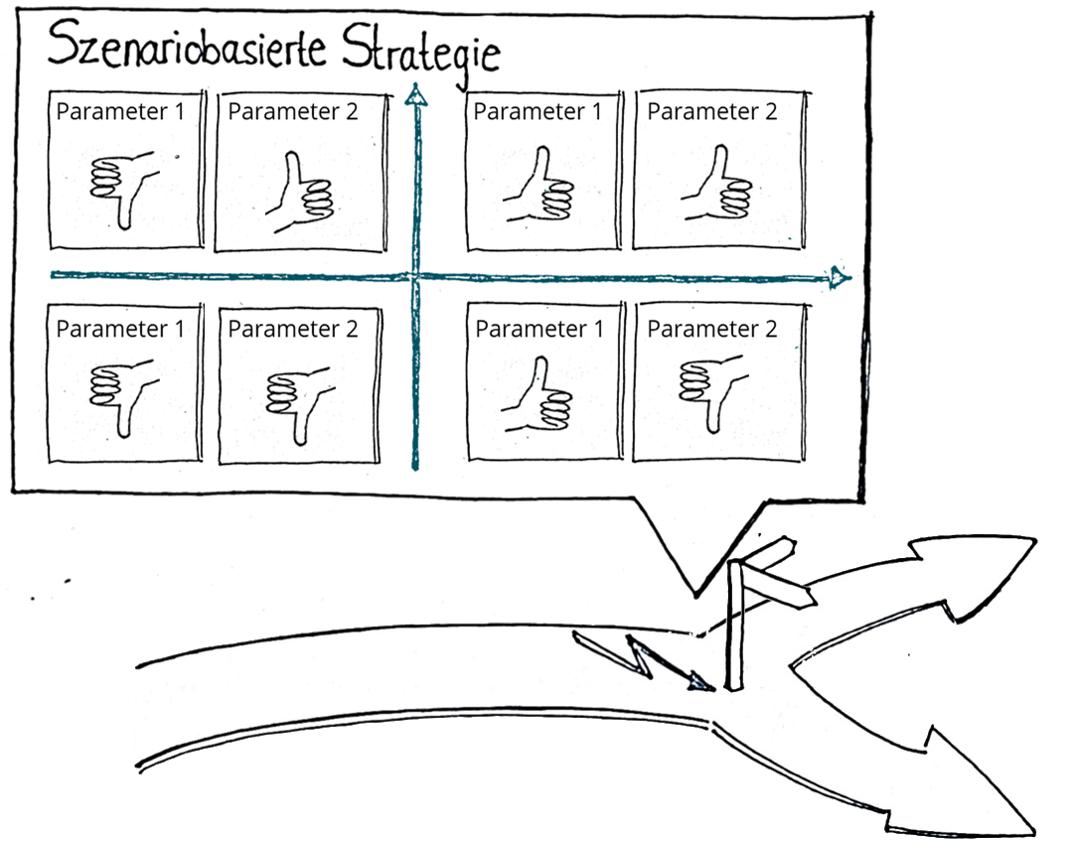
The scenarios are determined by external influences or changes in the environment of Merus. There are trends that are mutually dependent. For example, if a law were to be passed that bans chemical additives for water treatment, we would not only profit directly from this, but also our dealers. Also the way search algorithms work has an influence on how our website is found and how we can address customers.
From the trends we were able to determine two parameters, which are positive or negative for us depending on the change. This results in four fields and four scenarios (worst case, best case and two mixed scenarios where one parameter changes negatively and one positively). Now we had concrete ideas of what the possible future of Merus could look like. For each scenario we were able to work out key figures (When is the point at which this scenario is considered to have occurred?) and measures (What do we do when the time comes?).
For example, in the current scenario we have decided not to invest a marketing budget in trade fairs. Instead, we rely on online marketing, good content on our website, targeted online advertising and cooperation with product testers. This is the best way for us at the moment. If external circumstances change, we are able to react quickly and test other ways. So practice and theory always go hand in hand and we are flexible.
End of the blog series
This brings me to the end of the blog series. I hope I was able to give an insight into the fact that it is possible and useful to bring a bit of management into small businesses without restricting.
What added value can a strategy offer? Does it push my company forward? Do I need a strategy if my company is very small? These are questions you will probably inevitably be confronted with when it comes to reconciling (management-) theory and practice. I will summarize a few answers from both worlds here.
Strategic or Without Plan - SMEs in Germany
The term "strategy" originates from the military context and means loosely translated from Greek: to lead an army. Today it is about taking actions and decisions within the framework of a long-term plan. This plan, the strategy, is based on rational considerations that serve to achieve a central corporate goal. (NE GmbH | Brockhaus, 2014). A strategy should be at the core of entrepreneurial activity and affect all areas of the company.
This is a central requirement for strategy development - only if everyone accepts and follows the general "direction of the road" the company can profit from it in the long term.
In the previous blog post I talked about the likelihood of failure for new companies. In the literature it is generally agreed that companies with strategic approaches have a much greater chance of survival than companies without a plan. So "Think Big!" in the sense of "Think long term" is not only a question of mindset but can really be useful for the company.
Strategic management - tanker vs. fishing boat
The majority of companies in a market face similar challenges. These arise, for example, from economic changes, globalization or the general competitive situation.
Whoever masters these challenges best will win the competition, the race for customers and the largest market share. These external factors or challenges have different impacts on companies of different sizes. Just as a wave of the same size affects a large tanker less than a small rowing boat. Nevertheless, it is possible that the small boat will win the competition here if it navigates smartly and avoids rough waters early on. So even if the conditions are not equal, good planning and strategy can make the small boat, the small company, superior to the big one.
In other words, small companies in particular should have a strategy on which they can rely in times of crisis. Especially when there is no time to lose, the plan and the procedure should be fixed.
Does a strategy restrict me?
No. We at Merus had the approach: Our strategy is "no strategy". In the next blog post, I will show you exactly how this can be realized. In the course of developing a strategy, it should be identified which room for maneuver remains in the long term in order to continue to be successful. In other words, we have thought it over carefully: If we don't make any progress on the path we are currently on - what other options do we have? As a starting point for an uncertain future, it's not bad to have a plan B, C and D up our sleeve, isn't it?
Literature
NE GmbH | Brockhaus (Hg.) (2014): Strategie (allgemein). Brockhaus.
Since 1996 Merus has been successful as a small company for water treatment. The first intended target group were private households in Germany. The good results have led to the distribution of our sustainable solution for clean pipes also in industrial applications and across national borders. More and more new areas of application were added in which the Merus Ring can be used.
Small companies - targeted use of strengths
Newly founded companies have a 40% probability of failing in the first year. For the remaining companies, the failure rates for the first ten years are around 90% (Siegfried, 2015). This makes companies that manage to be successful in the long term even more interesting. For this reason, the first step of my master thesis at Merus was to examine the past. I wanted to find out what makes Merus successful in the long term and therefore so special.
A key sentence from my literature research on the topic is "A small company is not just a big company in mini-format! (Haag & Rossmann, 2015, p. 171). In other words: it is not very likely to be successful to simply apply the management approaches of large companies to a small company. Small companies have two decisive advantages over large companies:
1. short decision-making processes and decisions that are made with full expertise. I already touched on this point briefly in the last article. Where an employee combines several areas of responsibility, a lot of knowledge and information is also combined in one place. This applies to managing directors just as much as it does to employees from the various departments (sales & after-sales, marketing & customer communication, logistics & shipping, etc.). Every decision is therefore made fast and usually with many years of knowledge of all related processes.
2. flat hierarchies and short communication channels result from this and form a second decisive strength: flexibility. A small company is not only able to react quickly. It also has many more opportunities to develop further, to change its course.
Both strengths can only be used if the company is aware of them and is able to make the most of them.
Merus through the ages
Over the years, Merus has succeeded in constantly changing on various fronts and adapting to current requirements. First of all, the product is constantly being further developed. The aim is to increase the general effect and resistance to negative influences. In addition, Merus' field of activity has constantly expanded both spatially and in terms of industries and areas of application. Water problems in agriculture, building management and in production processes are now just as much a part of our applications as problems with other liquids and oil.
Of course, I was particularly interested in researching how Merus has shaped its external communication in recent years. For sales and advertising, the initial focus was classically on trade fair visits. Even then, however, Merus was already a pioneer in terms of marketing. A Merus homepage and ads via Google have been around since the early days. The design of the numerous flyers, packaging, brochures and the website was always adapted to the current taste at that time.
The goal of Merus' marketing has always been to lead potential customers to the offer. This gives us the opportunity to convince them of our solution through product tests. It means that we go where the problems arise. We are not interested in imposing ourselves or in selling our product where there is no demand.
To do this, it was and is necessary to constantly adapt our approach and strategy to current needs. This also includes trying out communication channels, failing to do so, learning from them and continuing differently. This constant movement and change in all three areas mentioned above has contributed significantly to Merus' success over the years.
What a plan, a strategy for the company can do and how it can be developed, I describe in the next article.
Literature
Haag, Patrick; Roßmann, Patrick (Hg.) (2015): Management kleiner und mittlerer Unternehmen. Strategische Aspekte, operative Umsetzung und Best Practice. Berlin u.a.: De Gruyter Oldenbourg.
Siegfried, Patrick (2015): Strategische Unternehmensplanung in jungen KMU. Problemfelder und Lösungsansätze. Berlin, Boston: De Gruyter Oldenbourg
In the next few blog posts I would like to write a little about working in an SME in Germany. The thoughts, data and research is taken from my dual studies in cooperation with Merus from 2016 to 2018. I started in 2014 as a temp for texts in German, English and French. The following dual master's degree with a focus on project management, business administration and technology was ideal for combining further education and my work at Merus.
What does SME mean?
SME is originally the abbreviation for "small and medium-sized enterprises". As this is a common term, I am using it for companies with a similar number of employees as Merus. Here I am referring to the number of employees at the main location in Sindelfingen.
In the following articles the characteristics of SMEs in general and Merus in particular will be discussed.
Flat, flatter, flattest - hierarchies at Merus
Where others work on flat hierarchies and short decision-making processes, this is part of everyday life at Merus from the very beginning. Each employee has a roughly defined area of responsibility, in which he or she is responsible for achieving the best possible results. Constant exchange instead of occasional, but lengthy meetings ensures a good overview. No employee is alone with the responsibility, but can, if necessary, obtain advice, opinions or input on his or her own projects.
That's also why the search for a topic for my thesis was based on practical experience and the decision was ultimately mine. Having already had an insight into the company, I had to decide what would add the most value to Merus. My goal was to plan and implement all corporate communications in such a way that Merus would be ready for the next 1, 3, 5 and 10 years. However, the concepts associated with each timeframe were as detailed as possible.
However, it was essential for the concept to include options for a quick reaction to any external and internal changes.
Freedom and Do-it-Yourself Communication
SME means for its employees: "We do this hands-on". In other words, we are doing what we can no matter if it is part of our job description or not. So I had almost infinite freedom to design videos, photos, brochures, promotional gifts and much more. And was enabled to plan, design and produce many of these myself.
Now I know what it means to realize a video from the idea to the film. When working together with external service providers for this kind of work, it helps a lot for the mutual understanding. But I also had to learn to choose the best one from the many possibilities and to determine which criteria could be relevant. Because even if I would be able to realize all of my ideas, unfortunately I have to select what is worth the effort and which project needs to wait.
If this text has risen more question marks than insights, I am satisfied. I would like to use the next three texts to present my work during my studies at Merus. That is when I would like to answer your questions.
We have now collected our data and also evaluated it or had it evaluated.As mentioned before, we want to present these data and results here.
The analysis refers to the business in the year 2019, it cannot be transferred to other years as it depends on the number, size and shipping route of the Merus Rings sold.
We therefore intend to make such a CO2 balance every year.
The CO2 footprint of Merus in 2019
Merus in Germany is responsible for the emission of 85 t CO2e (tons CO2 equivalent) in 2019.
This figure includes all activities of Merus GmbH. That means in addition to production and shipping, also the operation of offices, warehouses and employee travel. This figure can be divided into PCF (Product Carbon Footprint) and CCF (Corporate Carbon Footprint).
PCF or Product Carbon Footprint
The production and worldwide shipment of the Merus rings generates 45 t CO2e. Of this, 61% is caused by the raw material, approx. 11% by the metal processing of aluminium and 28% by logistics. The value of procurement logistics is comparatively low, as we mainly work with regional suppliers.
The disposal of the Merus rings generates almost no CO2. The aluminium is melted down and can be reused. Thus, the Merus Ring fulfils all requirements of the environmental authorities to produce products in a closed loop economy. And to return it to the cycle at the end of a product's life.
Theoretically, we thus obtain a PCF of 39 kg CO2e per kilogram of Merus Ring.
See here the actual 2019 PCF Balance sheet.
CCF or Corporate Carbon Footprint
The CCF of Merus is 40 t CO2e. This includes direct and indirect energy costs, i.e. heating, electricity and water with 18%. The lion's share is business travel. Our employees have travelled almost 70,000km on the way to the customer. This alone produced 22 t CO2e and corresponded to 62% of the CCF. The way to the office for the employees' work generates 9%. And most surprising for me personally, our internet presence with about 20,000 visitors per month generates almost 4 tons of CO2e or almost 11%. That is significantly more than I had expected.
These are the data from the CO2 balance of Merus. In the near future we will present the entire CO2 balance on our website.
What we do with this data and how to interpret this data is the next challenge.
An example: Owners of private homes in Germany
For this example we leave the logistics out of it. Without logistics, 39 kg of CO2 will be reduced to 29 kg CO2 for one kilo of Merus Ring. This figure applies to shipments in Germany which are not shipped by air freight.
The small rings ¾" to 1 ¼" are the rings of which we sell the highest quantities.
These small rings weigh on average about 220 grams. If we now calculate the 29 kg down to a Merus ring of 220 grams, we end up rounded up at 6.5 kg CO2 emission for these small rings. In this value the delivery on the street within Germany is already included.
Some numbers for comparison: To produce one kilogram of beef, on average 14 kg of CO2 are emitted (Müller-Lindenlauf et al., 2013). Two hours of watching Netflix will result in 6.4 kg CO2 emission (The Shift Project, 2019).
If we aim to achieve the climate goals of Paris, each of us should come up with a maximum annual CO2 emission of 2500 kg.
What is the next step?
In the first step we try to improve our CO2 balance. We reduce travel and air travel in particular. We are shifting production and our offices to electricity from renewable energy sources. Furthermore, recycling is still important to us. When all these larger and smaller measures have been implemented, we will compensate for the remaining CO2 emissions.
Merus wants to store the generated CO2 in trees. This means that we want to plant as many trees as it takes to store the CO2 we produce. This closes the cycle of CO2 emissions and the binding of CO2 in the form of biomass.
This is the only way we can speak of a truly sustainable solution through our product. By preventing or compensating any impact on the environment. We stick with Astrid Lindgren, who said in an interview: "I want to leave the world at least in the same condition as I found it."
That raises a number of new problems regarding how we implement these measures. The climate is already creating problems for us. The climate, and therefore the weather, is changing and more and more species that were once native are finding it increasingly difficult to survive in the current circumstances. Long periods of drought are affecting the forests. When you plant trees, you should be sure, among other things, that they will survive and thrive in the long term. Only then will seedlings become trees that are then able to store the predicted amounts of CO2.
More on this topic in summer.
Literature
Müller-Lindenlauf, M., Zipfel, G., Münch, J., Gärtner, S., Rettenmaier, N., Paulsch, D. & Rienhardt, G. (30. Juli 2013). CO2 Fußabdruck und Umweltbilanz von Fleisch aus Baden-Württemberg: im Auftrag der Marketinggesellschaft Baden-Württemberg mbH (MBW). https://www.ifeu.de/wp-content/uploads/IFEU-MBW_Fleisch_Bericht_2013-final.pdf
The Shift Project. (11. Juli 2019). Climate Crisis: The unsustainable use of Online Video: The practical case study of online video [Press release]. https://theshiftproject.org/en/article/unsustainable-use-online-video/
We started this project in mid-December 2019. As already mentioned in the first article on this topic, we have already switched the simple things like the electricity we buy to climate-friendly electricity from hydropower. So this is about further data collection, on our way to climate neutrality.
The production of the Merus Rings
We purchase the unfinished aluminium parts. Therefore we do not have our own machinery for metal processing, but we use companies in the local area that specialise in metal processing. In the southwest of Germany there are many such companies, which mainly supply the car industry.
From the beginning Merus relied on short distances to the suppliers. As in our opinion it makes little sense to buy the material in Asia or America, to refine it in Germany and then send it back overseas.
The actual purchase of the raw material is done by our suppliers. The quantities of aluminium are too small for us to influence where the bauxite is mined and processed into aluminium.
For our project "climate neutrality" we use average values for aluminium production for the route of the raw material. This means that the data relating to energy for aluminium production and transport to our supplier are determined in this way. We calculate the machine times ourselves, i.e. how much power the lathes or CNC milling cutters need to produce our Merus Rings.
As one of the last process steps, the rings are electroplated. During this process the raw aluminium is covered with a protective layer. This is necessary so that the rings are insensitive to corrosion during their later use. We have therefore calculated the surfaces to be treated and found that the power consumption for this process is negligible.
We will publish the exact figures for the manufacturing process later when we have all the information.
The laser marking of the Merus Rings, i.e. the logo and the serial number, is done with electricity from 100% renewable energy and therefore does not have to be included in our CO2 - calculation.
The refinement of the Merus Rings
At the end of the manufacturing process, Merus receives the rings ready to go. What is still missing is the finishing. The process step in which an aluminum ring becomes a Merus ring.
This process takes place exclusively in-house. And as mentioned above, we obtain 100% renewable energy from hydropower.
The way to the customer
Merus Rings are sent around the world. In 2019, the longest journey was a shipment from Merus to Buenos Aires, Argentina. That is a distance of about 11000 km.
But we also have deliveries that are climate neutral. These are customers from Sindelfingen, who come by and pick up their ring when they have been to the weekly market in front of our door. But the self-pickups are very few.
For our calculation we distinguish between 2 types of shipping. Either by truck or by plane. Most deliveries are made by a parcel service. Large deliveries on pallets by forwarding agencies.
For deliveries within Germany we have assumed a distance of 300 km and a delivery by road. For deliveries to Europe for distances up to approx. 1000 km, we also assume a transport by road. Whereby we calculate these deliveries exactly, from Merus in Sindelfingen to the address of our dealer in the respective country.
We are not able to follow the routes of Merus Rings abroad.
Now some numbers
In 2019 we sold Merus rings with a total weight of 1132.3 kg. If all these rings would have had the size ½", we would have sent nearly 6000 rings. If they had been 30" inches, however, we would have sent only 40 rings. The truth is somewhere in between, as usual.
We sent 217 deliveries by road and 61 deliveries by air freight:
That's 384.5 ton kilometers on the road. In the air, 4520.2 ton kilometers. And two or three were done on foot.
Ton kilometers - abbreviated tkm - is the transported weight multiplied by the distance. Together, the Merus Rings produced 4904.7 tkm in 2019.
We expect to be able to complete the survey of the figures by the middle of the second quarter. Then we will present the total amount of CO2 produced.
I am Roland Dworschak, the owner of Merus. This is the first time I am writing for our blog myself. The reason: this project is very important to me and it will keep us busy for the next years.
The Merus Ring has been a sustainable and very environmentally friendly product from the beginning, since 1996. It has a long-term effect, often replaces chemical solutions and causes energy savings. At the beginning of the marketing we tried to sell the rings with "environmental arguments". 20 years ago we found that very few customers were interested in these arguments. So we changed our marketing and from then on we only sold our rings on the benefits and the savings that could be achieved.
Times have changed, many people today feel that the climate is changing. And customers are open to discussing environmental aspects. We don't want to discuss at this point whether these changes are man-made or not, that is not constructive. But we have come to the conclusion: We should do something. Therefore, at the end of 2019 we started to work out measures on how Merus can operate in a climate-neutral way.
What we are already doing
For some time now, we have been using the train instead of the plane. When train travel is not possible, we compensate for our journeys. We have changed our packing material, try not to use plastic anymore. We use less and less paper and send brochures and invoices online.
Our project for this year - climate neutrality
In the first phase of the project we want to calculate how much CO2 we as a company actually generate. This includes the questions:
What amount of CO2 is emitted to produce one kilogram of aluminium and how much energy is needed to turn a large piece of aluminium into a Merus Ring?
How much electricity is needed for sawing or CNC processing?
How much energy is needed to engrave the serial number and our logo into the ring?
What distances does the Merus Ring have to cover from the supplier to us, and of course what distances do our rings cover on their way to our customers?
So we do not hand over our responsibility with the package to the carrier or parcel service, but we also consider the distance to our customers or dealers and the mode of transport.
Because a ring that we send to China by plane naturally has a different impact on the CO2 balance than a ring that we send to Berlin in a truck.
Milestones
The first goal is to determine the amount of CO2 that is emitted directly in connection with our business. Once this figure is known, we begin to avoid or compensate for it. However, we will write about this separately. Even when the project is in progress, we want to be completely transparent about how we calculate CO2 consumption and what we do to compensate for this amount of CO2. This means that where there is no climate-neutral solution, CO2 is bound elsewhere in a project, for example through reforestation or similar.
We have already implemented some measures. From 2020, Merus will exclusively obtain electricity from renewable energies, from domestic hydroelectric power plants. The engraving of the rings will also be done with electricity from renewable energy. Further measures are planned.
In the long term we also want to see how much CO2 can be saved by using the rings. In other words, we want to calculate the positive contribution to the customer's CO2 balance. So far, this has been extremely difficult, partly because each installation is of course unique. But in the end, what counts is not a figure on a piece of paper, but the actual contribution that each individual can make to climate protection.
Now the year 2019 is drawing to a close and we too can only tune in to the general whisper: "That went fast now.". Of course this is a classic opportunity for a little review.
One year Merus-Blog
Our small corporate blog has been around for one year now. These are twelve texts in which we explain, describe, list, present, expose and summarize what has no place elsewhere on the website.
This is how we have presented charitable projects that are close to our hearts. Always in the hope that perhaps a reader feels inspired to make a small contribution as well. After all, we can only preserve our world together. We have also taken up topics that we encounter again and again at work. Questions about Merus, the technology and the scientific background. We hope you have found some answers here. But ultimately, we still prefer to prove on site that our product delivers what it promises.
Finally, I had the opportunity to bring up some comparisons and examples and relate them to our way of thinking. Those who missed this can read in the previous articles what Merus has to do with ice skating, an apple or photosynthesis.
Merus around the world
Here at headquarters it was an eventful year with guests from all over the world and visits all over the world. We were invited to taste chocolates from Argentina, coffee from Thailand and tea from China. Apart from that we supported many new and interesting projects around fluid treatment. This is an enriching experience for both sides, especially when dealing with customers on site. On the subject of business travel: It is possible to compensate for CO2 emissions from flights. This means that the same amount of CO2 is reabsorbed elsewhere - by plants, for example. We are also currently taking a few big steps towards CO2-neutral production. I'll tell you about this in the blog when we get there.
New paths and proven methods
Last year we added two videos to our range of information. We would like to continue to prepare and explain more technical topics in the form of videos in the future. This is important to understand Merus technology in its overall context. We explain cooling circuits, heat exchangers, key figures and, of course, the Merus Ring. So far two videos are available, everything else will be produced step by step. We are particularly pleased that Merus' holistic approach is made clear in this way: We always look at the entire system and thus combat its weaknesses in terms of deposits, corrosion or biofouling.
To conclude the old year and begin the new one, we would like to thank everyone who has contributed to Merus as a partner, customer, supporter, colleague or friend. Thank you for sharing our idea of clean water and making our work so colourful.
I have reached the last part of the blog series "Empirical evidence". After I wrote about the meaning of theories and the "Trial and Error Principle", it's time for practice.
Water is a "chemical curiosity", as it is described so accurately in the Spektrum special issue. This means that under certain circumstances it behaves differently than expected.
Anomalies of water
The best known anomaly that water shows is certainly the density anomaly. While other substances reliably lose volume when they cool down, water behaves quite differently. Its density only increases until it reaches a temperature of 4°C but then, as it continues to cool down, the density decreases. The water therefore expands again - this is the reason why you should take care to remove beverage bottles from the freezer before they explode.
However, new discoveries are made regularly about the properties of water.
Water is able to store large amounts of heat without heating itself excessively. This is decisive for our climate, for example in the form of the Gulf Stream.
One of the more recent findings is that water is "lumpy". The water molecules form stable bridges with each other. These bonds ensure that stable structures exist in the area of molecular vibrations, which presumably determine the thermal conductivity of water.
Why is this important?
Life on earth is essentially dependent on the occurrence of water. It is crucial for biochemical processes in living beings, it determines our climate and makes our planet a habitat. The more characteristics of water we know, the more we can utilise these actively.
However, we do not yet fully understand all the properties and peculiarities. For example, it is not certain why ice is slippery and how we can skate on it. It is also not conclusively explained why hot water freezes faster than cold water (Mpemba effect). Nevertheless, we still use it when preparing ice rinks in the stadium, for example.
What does this have to do with Merus?
When it comes to the characteristics of water that have not been fully researched, but which can be used in a targeted way, we become attentive. After all, this is the secret behind Merus technology. We know that the molecular oscillation can be specifically influenced. We also know how to increase the solubility of water-soluble substances in this way. However, the space for unexplored interrelationships and characteristics is enormous. So we are content with what we know and use it for water treatment without chemical additives.
Literature
Lars Fischer: Wasser ist klumpig. Hg. v. Spektrum KOMPAKT (Wasser - die rätselhaften Eigenschaften von H2O). Available online at https://www.spektrum.de/news/wasser-ist-klumpig/1366449, last checked on 24.10.2019.
Philipp Hummel (2014): Wenn Heißes schneller gefriert. Mpemba-Effekt. Hg. v. Spektrum der Wissenschaft, last checked on 27.01.2014.
Warum können wir Schlittschuh laufen? Was wir noch nicht wissen: ARD-Alpha. Available online at https://www.br.de/mediathek/video/was-wir-noch-nicht-wissen-warum-koennen-wir-schlittschuh-laufen-av:585dc9163e2f290012a9ada1, last checked on 24.10.2019.
Wolfgang W. Merkel (2010): Immer mehr bizarre Eigenarten beim Wasser entdeckt (DIE WELT). Available online at https://www.welt.de/wissenschaft/article8211071/Immer-mehr-bizarre-Eigenarten-beim-Wasser-entdeckt.html, zuletzt aktualisiert am 30.06.2010, last checked on 24.10.2019
Reading this blog you might have already noticed that I am a big fan of illustrative comparisons and unusual examples. Also in the second part of this series "Empirical evidence" I will take up a branch of research that has nothing to do with our actual industry. However, the way in which research is conducted can be compared with our approaches. So if you have difficulty recognizing the goal of the article at first glance, don't worry. At the end, there is always the section "What does this have to do with Merus?. My sources for reading I mention again at the end of the article.
"Artificial photosynthesis is the holy grail of research.
Basically, plants convert light energy into storable chemical energy during photosynthesis. Some algae and bacteria are also able to perform photosynthesis. Sunlight is used to produce carbohydrates from water and carbon dioxide, which serve as energy storage. This process is a crucial part of the cycle of life. Not only does it provide food or fuel, it also releases essential oxygen.
If this process could be optimized or even artificially simulated, a large part of the challenges of our time around climate change and scarcity of resources would be a thing of the past. For this reason, research into this is extremely attractive.
Dealing with assumptions in research
The research works with various assumptions or hypotheses, which are tested and on the basis of which further research can then be carried out. This means in this case:
1st assumption: Different living beings are able to carry out photosynthesis and can thus chemically store energy in the form of carbohydrates. This is followed by an investigation of the process itself. Which steps, chemical components and prerequisites are necessary?
2nd assumption: The process has been completely researched. It is now possible to change individual components and observe the effect.
3rd assumption: It might be possible to artificially recreate the process. On the basis of this assumption, research is carried out in which empiricism is used alongside work and theory. That means simplified: Trial and Error. Each experimental setup consists of many variables and factors, which are successively checked, changed and re-checked. This is repeated until the desired result is achieved. In this way, the research comes step by step closer to the goal of "artificial photosynthesis" in the ideal case.
What does this have to do with Merus?
I try to keep my promise from the introduction and now draw a bow back to our work at Merus.
In the first part of the blog series, I explained how every successful installation supports our theory of the Merus Ring. From time to time we also make installations where we can't predict exactly how the effect will occur. This is the case with very large, complex applications or with new types of problems. If everything works out right away, that's excellent. Sometimes, however, it is almost better for our wealth of experience if the effect does not occur immediately but only after changes have been made to the installation. This gives us insights that we can apply to the next customer and that broaden our understanding of the technology. (Of course, such cases are discussed in advance with the customer so that he knows what to expect or what he may expect). Occasionally we can even reduce the number of Merus Rings installed with the same result, making water treatment cheaper. So we get to know the limits of the technology.
The example "Research on photosynthesis" is intended to show that our approach is by no means unusual. Experiments and evidence that have been empirically determined are always part of scientific work.
We are actually in the middle of a blog series. However, I would like to use the current news about fish dying in a lake in our region to discuss the biological oxygen demand (BOD). The processes in the lake and in the water are directly related to our work, however, in a different context than we usually use the BOD. The article is intended to supplement the glossary entry and also to deal with the problems and solutions for the domestic pond.
Biological oxygen demand (BOD) in Lake Max-Eyth
Max-Eyth-See in Stuttgart is an artificial lake that was created by gravel mining at the beginning of the 20th century. In the 1930s, the area around the lake was transformed into a recreational area. It is under landscape protection. In summer the lake can be used for boating, but swimming is not allowed.
The lake does not have its own fresh water supply and is therefore an ecosystem in itself, which gets out of balance summer after summer. Ongoing warm temperatures favour in particular the growth of blue-green algae, which spread rapidly. As the lake is shallow, it warms up particularly quickly and is also highly endangered. Plants that have been able to grow in the lake are cut off from the sunlight by the blue-green algae and die. They gradually sink to the ground, where they are decomposed by bacteria. Similar to us, these bacteria need oxygen for their metabolism. They receive this oxygen from the water. The more dead biomass there is, the better for the bacteria. This increases the BOD, i.e. the need for oxygen to break down the biomass.
Innocent victims - fish deaths
At a certain point in the lake, more oxygen is consumed than can get into the water through the surface of the water. If this development is not detected and stopped in time, no oxygen remains for the fish in the lake. To a certain extent, they suffocate in the water.
This year the death of fish was particularly devastating. Within a few days, about 50,000 fish died. The lake is "tilted", as the vernacular says.
Measures against the lack of oxygen in the water
Firstly, aquatic plants can be specifically used to filter nutrients out of the lake and release oxygen again. This works in a similar way to the indoor plant that provides good air in the living room at home.
Secondly, it is important to circulate the water in the lake or pond. That means nothing else than to increase the water surface so that more oxygen gets into the water. For example, fountains or small waterfalls serve this purpose. In this area we are also present with our Merus rings. If you have already read on our homepage, you may be familiar with the following sentence: "The Merus rings increase the solubility of substances soluble in water". This also includes oxygen. If the water is treated with our technology, it is theoretically able to absorb more oxygen. Of course, this is only useful in practice if there are sufficient possibilities for oxygen to enter the water.
The third possibility is actually the most obvious, but it is difficult to implement, especially in large lakes: If fresh water is constantly supplied, the low-oxygen water is diluted. In this way an increased BSD can be compensated.
Literature
Julika Wolf (2019a): Anglerverein zum Fischsterben im Max-Eyth-See. „Größte Naturkatastrophe, die es in Stuttgart je gegeben hat“ In: Stuttgarter Nachrichten, 04.09.2019. Available online at https://www.stuttgarter-nachrichten.de/inhalt.fischsterben-in-stuttgart-max-eyth-see-wird-noch-bis-samstag-belueftet.17f728eb-d3ee-4c41-a000-d8263d65281c.html, last checked on 11.09.2019.
Julika Wolf (2019b): Fischsterben in Stuttgart. Was passiert mit dem Max-Eyth-See? In: Stuttgarter Nachrichten, 06.09.2019. Available online at https://www.stuttgarter-nachrichten.de/inhalt.fischsterben-in-stuttgart-was-passiert-mit-dem-max-eyth-see.007eafe8-a8d3-4a01-ac90-cae835a07d26.html?utm, last checked on 11.09.2019.
Stuttgart-Marketing GmbH (ed.): Naherholungsgebiet Max-Eyth-See Stuttgart. Available online at https://www.stuttgart-tourist.de/a-max-eyth-see, last checked on 11.09.2019.
In the series "Empirical evidence" we will pick up examples illustrating how we make use of processes without fully understanding them. To get started, I would like to begin with a fundamental phenomenon - one of the basic principles of our life on earth.
What do the laptop on your desk, me on my office chair and a cruise ship on the ocean have in common? We are all under the influence of gravity. A force so self-evident that I never worry (or doubt) about it. It holds us together on Earth and our universe as we know it. At least the part we know.
Theory of Gravitation
I'm sure we all know the story about Isaac Newton and the apple that fell on his head. At the end of the 17th century, this apple is said to have given the impetus to Newton's theory of gravity. Einstein's theory of relativity then further clarified but also complicated the considerations about gravity.
In order to continue writing, I must now quote foreign sources, in other words, parrot what others understand, because I am at the end of my Latin: Gravity does not directly influence a body. Rather, the mass of a body deforms space and time. Other bodies are attracted to these deformations, so that in the end the masses attract each other. The earth as a very large body (in comparison to a human being) thus leaves a large deformation behind - this results in the earth's gravitational pull. *
Sounds complicated? Yes, because even physicists do not fully understand the principles on which the whole thing is based.
What does this have to do with Merus?
The theory behind gravity is irrelevant to us in practice. As long as the cruise ship mentioned at the beginning stays on the water and doesn't float towards me in the pedestrian zone; as long as the laptop stays where it is, I'm satisfied.
We all rely on gravity and use it even though we don't understand it. What we understand is its effect in practice. Because we have observed it a thousand times in our lives. Every apple falls in the same way from the tree when its time is ripe. Namely straight down to the ground.
Theory and practice.
Just like the theory of gravity, the theory behind the Merus Ring sounds a bit weird. It has gaps and is constantly being researched in order to close these gaps. But the practice is simple: where the problems disappear after the installation of a Merus Ring, we can be sure of the effect. For the customer this is decisive and for us every time a further proof of our theory.
*Source: Deeg, Janosch; "Die 10 größten physikalischen Rätsel unserer Zeit" published in Spektrum der Wissenschaft, 30.10.2014. Last updated on: 15.07.2019 under Spektrum.de
The last two blog posts take up our thoughts on the subject of "evidence". We are often concerned with how we can prove our technology in order to reduce skepticism. We have decided to deal openly with it, to allow all doubts to be discussed and then to convince with good results. We bring the "proof" for the effect of our technology individually on site with you or other customers.
The motto is: even if I don't understand how something works, I can still be convinced of the result.
Blog series: Previously unproven phenomena
I am sure that each of us uses an object or a device that we do not fully understand. For some it is the car, for others the Internet, the television or electricity from the socket.
With this in mind, I would like to launch a new blog series that takes up three phenomena that we generally accept as given. We do not question them further, although we do not understand why they work and we cannot prove them. Only tests in reality, i.e. empiricism, provide the same results again and again and thus provide evidence. Meaning that research does question these phenomena, but I personally question them less.
What is exactly a theory?
Figuratively speaking, one takes everything one knows and tries to derive certain laws from it. In the beginning there is the realization that a certain behavior or a certain state always causes the same reaction. In the second step, an attempt is made to explain the reason for the connection. So the cause is investigated.
Occasionally it is useful to present the findings as a picture so that more people can imagine what it is all about. An example is the Bohr atomic model in which the atomic nucleus and electrons of different substances are depicted. For example, such pictures or models were also created to explain light, electricity and magnetism. Roughly speaking, these models together with the laws derived from them form a theory.
If new insights are added, theories can be changed, expanded or narrowed. Occasionally they are also replaced by a completely new theory, one speaks then of a paradigm change.
Why do we need theories?
Our daily life, nature and its processes bring new cases to light every day. It is not possible to scientifically test every process. Theories and models thus serve to classify and quickly understand new case studies. So we try to understand the logic behind a process and thus derive explanations for each further case.
What's that got to do with Merus?
When we explain how our water treatment works, we use a vibration model. All our results can be explained on an atomic or molecular basis with their oscillations. By understanding this logic, we are able to advise different customers with different applications.
Our theory is supported by every single installation we have studied over the past 25 years. This proves the hypothesis that our Merus ring is effective against deposits, corrosion and biofouling. At the same time, we refute the assumption that the technology is not working. This means that even if our technology is partly a trade secret and partly unexplored, the results prove its effectiveness.
"Don't trust statistics you didn't fake yourself." In times of fake news and information overload on the Internet, it is perhaps more important than ever to look closely at what is sold to you as "truth".
A question we are often asked:
"IS THERE EVIDENCE OF THE FUNCTION OF THE MERUS RING?"
We know exactly what you mean, but the question is not so easy to answer. Most customers would like to see a study that shows how the Merus Ring works. This means a clear connection between cause and effect.
Part of the difficulty with studies on the Merus Ring is that the applications are so diverse. For example, we have a study that shows that there is a link between successful fish farming and the treatment with Merus Rings. However, this result is of little use to you if your problem is in drinking water, the cooling tower or the washing machine.
Much more important, however, is that according to the principles of scientific work, a fact can never be proven. A simple example: No car manufacturer in the world will be able to provide you with proof that your own car drives and give you a lifetime warranty on its roadworthiness. Rather, the characteristics of the car have been tested so often that we now have experience with the life of the vehicle. If you take good care of your car and use it according to the manufacturer's instructions, you will enjoy it for a long time.
Over the years, we have also installed thousands of Merus Rings under a wide variety of conditions. Some are in ideal surroundings, others are in unfavorable areas.
If possible, we check the effect either by visual examination or by data analysis (in the industry). If the Merus Ring is installed correctly, its effect is unlimited. This also means that every single successful installation strengthens the assumption that the Merus Ring works. (In the context of scientific work: we refute in a kind of long-term study the hypothesis that the Merus Ring does not work.)
ANALYSIS AND CONSULTING
Where there are difficulties, we analyze the situation and, if necessary, change the installation. This is the case if i.e. the effect does not correspond to the expectation. We then use comparable cases in our database and work out options for solving the problem. This can be a change in the installation location or an increase in the number of Merus Rings installed.
We, therefore, use our empirically determined data (in short: experience) as evidence for the effect of our technology. So that you do not have to believe any statistics, but can make own experiences, we usually offer trial phases or rental.
In the next two blog posts, I will pick up questions that we encounter again and again at work. Because both can't be answered so easily in a few words, a blog post (or two) is needed.
"Do you have the patent on the Merus Technology and the Merus Ring?"
To answer this question, I refer to information provided by the German Patent and Trade Mark Office and to considerations made when founding Merus. A patent is intended to protect a product or process from imitators. It is valid for 20 years and can be extended beyond national borders if required.
This means that Merus has been around for around 25 years, and the technology has been around even longer. If there had been a patent, it would have expired already.
And this is also where the argument begins, which has spoken and still speaks for Merus against filing a patent application. The patent application contains a detailed description of the "invention", which can also be supplemented with drawings and examples. This also means that any freeloaders could now access this information and launch similar products on the market. A patent valid for 20 years in Germany costs about 14,000€ over the years. In addition, there are possible costs for lawyers, etc. if it should be necessary to defend the patent. After all, a patent on paper does not make the invention unassailable.
We are also active worldwide. This means that only by having a patent in Germany is our Merus Ring still far from being protected from imitators. Which, of course, increases the costs many times over.
All in all, we are of the opinion that a patent and everything that goes with it is more expensive than the risk of copies. The patent is not financially worthwhile for Merus.
What makes Merus different?
This question brings me to the second part of my detailed answer. A patent can make sense if you want to prevent an invention from being copied and thus lose customers. In addition to the Merus Ring and the technology, however, it is crucial that our Merus Ring is installed correctly in the right place. This is particularly important in industry. In the case of kilometer-long branched lines with hundreds of devices, the planning of the installation is the main part of the work.
The most important part of our product is the consulting service, which is based on many years of experience. It can neither be copied nor protected.
This means that a Merus ring, without the necessary knowledge about its use, is basically useless, which is why we have decided against filing a patent application and are very satisfied with it so far.
Our idea of sustainability refers to the fact that we are all part of a large cycle. The living beings in this cycle are interdependent. This means that everyone has their role and is important for the continuity of the system. So we have to admit that even the smallest, most annoying mosquito is somehow useful and every spider has its right to exist.
What we (and many others) have noticed this summer is that the number of bees and other pollinating insects seems to have decreased. Whereas according to a "large inquiry" of the Green Party to the federal state parliament in Baden Württemberg (Germany), the number of the bee colonies is stable or even increases. Thanks to active beekeepers, whose number slowly increases with the awareness of the problems of bees.
All bee species are threatened by pesticides, changes in the landscape, mites and diseases. Thanks to the beekeepers in the country, these problems can be solved in the case of the honey bee. However, honey bees, as well as wild bees, are necessary for biodiversity and sufficient pollination of the plants.
Why are bees so important to us in general? After all, it is easy to do without honey alone. According to the "Landesanstalt für Bienenkunde (LAB)", an institute at the University of Hohenheim in the south of Germany, the pollination of cultivated plants in Europe by bee colonies is worth approximately 65 billion euros. This means that the actual value of bees' work for all plants is unimaginably high and cannot be quantified scientifically.
Bee-Sponsorship
After a discussion over coffee about ecosystems in general and bees in particular, the idea to support the care of local bees arose in the office. So in spring, we contacted a beekeeper from nearby our headquarter for a bee sponsorship. The "sponsor" pays a more or less small amount and thus finances part of the work for a beehive. The aim is to publicize the needs of bees and to promote biodiversity in other ways. For example, by planting different meadow flowers in cities (so-called "sealed areas").
At the beginning of the sponsorship, we had the opportunity to visit the bees and meadows in the beautiful book and to take photos of them. An impressive morning! We were not only enthusiastic about Mrs. Hafner's work. Also, how calm the bees behave in and around the hive is fascinating. Even panic-stricken fellow men realize there that headless running in circles and screaming in the face of bees is not necessary :).
So if you feel like getting involved, just buy a small bag of meadow flower seeds and plant them in your front garden or on the balcony. There are also bee sponsorships everywhere in Germany to make a financial contribution.
The sponsorship has brought us new insights, excellent honey and lots of fun.
To celebrate the 20th anniversary of the company 2016, we have started a fundraising campaign for the German non-profit association "Viva con Agua de Sankt Pauli e.V.". In the anniversary year, we set aside 5€ for each ring sold. At the end of the year, the collected contributions were donated to Viva con Agua. We are now "Supporter" since then and have contributed again last year.
The association is committed to clean drinking water all over the world. For example, wells are being built in the dry regions of the world for this purpose. The aim is to provide everyone with easy access to clean water.
Donations are collected by the association with different actions. Viva con Agua can be seen at concerts and festivals, for example. Here, deposit cups and bottles are collected and the proceeds from the deposit are used for our own projects.
So why did we choose Viva con Agua as our anniversary project?
Drinking water stands for the beginning of help for self-help in dry countries and for the end of the journey of water through the world. Our whole life revolves around it, even if it is not a conscious thought for me personally and luckily I don't have to worry about it. We are of the opinion that this should apply to all people on earth.
Viva con Agua Picture by Melanie Haas
After all, no economy can develop without water. Anyone who walks many kilometers to the nearest well every day and then has to queue for its (polluted) water for a long time cannot go to school or work. The resulting poverty once again means that labor plays a greater role than education. Without water, the development of a region towards prosperity is impossible. Viva con Agua is at the forefront in Germany when it comes to presence and training on these topics, which are important to us all. So we decided to make a small contribution through the donation in order to make more drinking water available to more people.
We are convinced that respect is the key to sustainable success. This respect applies to business partners, customers and nature.
When I read it that way, it sounds a little bit like phrasemongering to me. In fact, however, long-term relationships with business partners can only develop if you meet at eye level. More than 25 years of Merus prove this philosophy right. Sustainable success = success that sustains.
For our everyday life this also means that we do not carry out any nonsensical installations. If we believe that the interested party does not need water treatment, we will say so openly. This can be the case, for example, in areas with very soft water. We don't talk anybody into this.
Guiding principles for our business relationships
Three basic ideas are important to us:
Every customer should decide for himself for our solution and our product. Only in this way can it live up to its expectations. We support with information and generous test phases. But never force us on.
We treat our business partners fairly. Transparency and openness are important to us. After all, everyone benefits from long-term, positive partnerships - we, the partner and the customer. Experience results in expertise and ultimately in good advice.
Respect for nature - quite hackneyed and difficult to implement. We are operating worldwide and often also personally on site. In general, we carefully consider the necessity of a trip. For a single appointment we do not fly around the globe and accept the CO2 emissions. Our products are all manufactured around our headquarters in Sindelfingen. This means that long transports between the production sites are not necessary.
We reuse (also) old packaging material for the journey to the customer so that as little waste as possible is produced. Filling material for padding or cardboard boxes are thus used more than once.
Most importantly, however, in many places we are helping to reduce the amount of chemicals that get into the water. Where Merus rings are installed in industry, less or no chemical additive is required in the water to dissolve lime or other deposits or to remove algae.
In this way we contribute at least a little to environmental protection.
In the next few articles I would like to present three projects that we at Merus support financially. They all have the idea of seeing us as part of the environment. Without unspoiled nature, survival is not possible for us as a company and as people.
Merus is associated not only with a journey through time (90s until now), but also with journeys around the globe. This year alone, my colleagues and I have flown a total of about 80,000 km. This corresponds to a journey that extends twice around the equator.
- How we try to balance our CO2 balance, I will take up in one of the next articles. -
Our journey takes us to places that could hardly be more diverse. From the hull of a ship to an oil rig, from a pineapple plantation to a wastewater treatment plant.
By the way, did you know how pineapple grows? I was surprised that it does not hang at all from the tree (keyword: "Pine-Apple"), but rather grows on a shrub rather near the ground.
PEOPLE, PEOPLE, PEOPLE
Sometimes it is the small conversations that bring the most joy. When the municipal employee thanks us for making the fountains wonderfully easy to clean thanks to Merus, we have done a good job and are happy about the success with him.
Occasionally, however, there are also large projects that provide a special motivation at work.
When it comes to chemicals in cooling and waste water, for example. Then at the beginning of a project there are often long and difficult discussions. The "5 phases of scepticism-management", which I have lovingly described, must always be overcome: Skepticism/ Dislike - Disbelief - Interest - Acceptance - Surprised Enthusiasm
The fifth phase is only achieved after a test installation at the customer's site. Particularly skeptical interested parties can only win when a test is carried out. Suppose the Merus Ring doesn't work. Then they've "known it from the beginning" and look good. However, since the Merus Ring usually works well and large sums of money are saved, they were pioneers of the new technology and also benefit.
Thus, the biggest skeptics ultimately become satisfied customers and occasionally even multipliers of our technology.
What about us? We go home with the good feeling that thanks to our work a little less chemistry gets into the sea again or energy is wasted. So we like to fight many small battles and install environmentally neutral water treatment step by step. After all, the war to protect the environment is far from won.
What began 25 years ago in Germany is now being continued worldwide.
The Merus story is a story that has always been about finding new ways to contact customers. For us it is and was important to recognise trends, try out different media and talk and listen a lot.
We learned a lot and tried a lot. Of course, not every plan you think about will work.
We also had to get to know our customers bit by bit. Where direct contact via trade fairs or telephone conversations used to be important, today all information has to be prepared for the Internet.
The most important lesson?
Do not assume from the own taste to that of others! At the beginning of the 2000s it was time to say goodbye to the style of the 90s. By this we mean not only flared trousers and platform shoes, but first and foremost the corporate design of Merus. That had become a bit out of date with a lot of colour and colourful pictures.
So a new, "adult", classic design in elegant blue was developed. But the world was apparently not yet ready for it.
That means then on multiple desire of the dealers and customers: Roll backwards, the old packagings and flyers are out again and the revolution in design is shifted backwards.
So now a blog...
... Right. We would like to tell you a little about what is important to us and who is behind Merus. With the blog we create a platform for all our ideas, encounters, experiences, without spoiling the clarity of the homepage. So the whole project should be carried out apart from explanations and case studies, apart from business, even if both are interlinked.
The writing is mainly done by me, Annika. I have been working for Merus since the end of 2014 and have completed my master's degree in a cooperative study program with Merus. I'll make that an issue at an appropriate time. My colleagues and our managing director will also contribute some texts so that different stories will be told.
We are looking forward to telling you more about us and look forward to your feedback.
In this sense: Have fun reading.




 The scenarios are determined by external influences or changes in the environment of Merus. There are trends that are mutually dependent. For example, if a law were to be passed that bans chemical additives for water treatment, we would not only profit directly from this, but also our dealers. Also the way search algorithms work has an influence on how our website is found and how we can address customers.


